
SPECTRAL KIN: QUEER GHOST DOGS IN DEVON
By Mitchel Rowe

(Brown)

(Reagan)
“Without Sustained remembrance, we cannot learn to live with ghosts and so cannot think”
(Hawaway, Staying with the Trouble, 39)
“the most striking characteristics of the Barguest type is that it goes out of its way to show the beholder it is no normal dog, but a monster from another world”
(Brown, 178)

(Humberstone)
THEO BROWN
British scholar of Devon folklore, lecturer in Comparative Religion at the University of Exeter.
Theo Brown (1914-1993) was a prolific folklorist and gathered a large collection of stories and traditions on Devon’s supernatural history.
While it is convincingly possible to speculate on Brown’s queerness during her lifetime, this section of the ‘Out in Nature’ trail focuses instead on reading her large body of work through a queer lens. Particularly, Brown’s ghost dogs invite us to consider what kinds of queer kinships we might maintain with “normal dog[s]” and “monster[s] from another world” (Brown 178).
 GHOST DOGS IN DEVON
Did you say “GHOST DOGS“?
Theo Brown prolifically contributed to the academic study of folk-lore in and around Devon, with her notes and research donated to the University of Exeter’s Special Collections archive in 1993.
“It is now some years since Dr Margaret Murray suggested I should attempt a survey of this ubiquitous ghost. The picture is by no means complete, but it is beginning to stabilize, and certain patterns are beginning to emerge that suggest some tentative theories” (Brown 175).

(Brown, 177)
Theo Brown’s research combined thorough historical scholarship, folklore studies, statistical analysis, and a suggestive flair that makes her an integral part of the University of Exeter’s flourishing natural tapestry. Regardless of any belief in Devon’s rich folklore, Brown’s work defines and examines the cultural understandings of the natural world, understandings that undoubtedly continue to shape West-Country peoples’ lives today.
According to Brown, the ghost dog is “far more widespread than one would have imagined, astonishingly persistent, and perplexingly versatile, serving as an image for a very large assortment of situations” (188). More than this, Brown suggests these dogs are “more friendly than has been supposed,” and engage in mutual kinship with other beings including spectral playmates (188).

(Marcandier)
HOW CAN GHOST DOGS BE QUEER?
I’ve heard of queer people but never queer dogs… and ghosts no less!
Here, we turn to American scholar, Donna Haraway, and consider how Theo Brown’s ghost dogs might be understood as a “companion species” or a “queer kin group” (Haraway, When Species Meet, 10).
According to Haraway, it is not only important to consider how we exist with animals, but necessary. She writes: the “discursive tie between the colonized, the enslaved, the noncitizen, and the animal” is “at the heart of racism and flourishes, lethally, in the entrails” of negligence (When Species Meet, 18). In short, Haraway’s work suggests it is necessary to think critically about our relationships with non-human animals if we are to strive for equality. This involves “queering” how we think about others (Somerville 203).
Reading Theo Brown’s research with Donna Haraway’s gives us the chance to consider what queer connections we might have with our fellow beings, fleshly or spectral. So, in Haraway’s words, let’s seek “siblings in the nonarboreal, laterally communicating, fungal shapes of the queer kin group” and “induce panic in the centers of power and self-certainty” (Haraway, When Species Meet, 10).

(Penguin)
WHAT IS QUEER ABOUT THE GHOST DOGS IN DEVON?
What is radically queer about Theo Brown’s spectral canines?
Theo Brown’s work evidences not only a deep fascination with anecdotes, local history, and folklore, but a desire for empathy and understanding. Underpinning her work is a radical diversity in the representation of “Devonshire dogs … being of very mixed character and origin” (80). Rejecting both the essentialist views of British, literary depictions of black dogs, and her contemporaries, Brown’s work seeks nuance and multiplicity at a time when, as one 20th Century folklorist described them, “the devil in dog form” was running rampant through the moors (Woods 229).
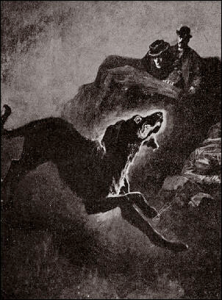
Brown paved the way for what Donna Haraway terms “contact zones” between human and non-human beings, and popularised a kinder, queerer understanding of ghost dogs through her prolific works including: Fate of the Dead (1979), Devon Ghosts (1982), and many more. “So much for a general view of the Black Dog,” Brown writes playfully, “Now for some variations found among individuals” (180). Dogs with a “Woman’s Face … Talking … Walking on hind legs … [and] Coming from the Sky,” Theo Brown’s ghost dogs are “entanglements … [and] contact zones” where the human and non-human touch (Brown 181; Haraway, When Species Meet, 4). Her work allows us to fracture the “Great Divide” between Man/Other as the ghost dog does Life/Death (Haraway, When Species Meet, 9).
Furthermore, Theo Brown’s work teaches us the Harowayian politics of “be[ing] polite” to our non-human kin so that our relationships might be queered for the better. As she writes in “The Black Dog”:
“In general, most of the Black Dogs I have listed are not offensive. Most of those who have been injured were asking for trouble, either by attacking the dog or running away from it, which is exactly what we should expect from a real dog”
Brown stresses, as Haraway terms it, the “multipartner mud dance issuing from and in entangled species” living across shared spaces and different times, and insists “the Black Dogs … are not offensive” but responsive, always “becoming-with” their human interlocutors (Haraway, When Species Meet, 32; Brown 187; Haraway, When Species Meet, 32).
(Paget)
WHAT CAN THEO BROWN’S WORK TEACH US TODAY?
The ghost dogs have been queered, what now?
Brown’s work has sat comfortably in Devon’s heritage as an interesting, if not eccentric, piece of the past for two decades. However, through considering its queer afterlife on this trail, we might revisit her work as a keystone in the changing relationship between humans and non-humans, relationships that are inevitably queer, polite, and radical.

(Brown)
BIBLIOGRAPHY
Brown, Theo. Theo Brown personal and research papers. 1920s-1993. Special Collections
Archives. EUL MS 105/1. University of Exeter.
Haraway, Donna. Staying with the Trouble: Making Kin in the Chthulucene. Duke
University Press, 2016.
—. When Species Meet. 2007. University of Minnesota Press, 2008.
Humberstone, Ian. “Theo Brown and the Folklore of Dartmoor | Caught by the River |
Caught by the River.” Caughtbytheriver.net, 2025,
www.caughtbytheriver.net/2014/06/theo-brown-and-the-folkore-of-dartmoor/.
Accessed 3 May 2025.
Marcandier, Christine. “Donna Haraway : ‘Notre Existence Dépend de Notre Capacité à
Vivre Ensemble’ (Manifeste Des Espèces Compagnes).” DIACRITIK, 26 Mar. 2019,
diacritik.com/2019/03/26/donna-haraway-notre-existence-depend-de-notre-capacite-a-
vivre-ensemble-manifeste-des-especes-compagnes/. Accessed 3 May 2025.
Reagan, Romany. “Spectral Animals: Ghost Pets to Hellhounds.” Blackthorn & Stone, 16
Apr. 2020, blackthornandstone.com/2020/04/16/spectral-animals-ghost-pets-to-
hellhounds/. Accessed 2 May 2025.
Somerville, Siobhan B. “Queer.” Keywords for American Cultural Studies, Second
Edition, edited by Bruce Burgett and Glenn Hendler, 2nd ed., NYU Press, 2014, pp. 203–
07. JSTOR, http://www.jstor.org/stable/j.ctt1287j69.57. Accessed 5 May 2025.
Woods, Barbara Allen. “The Devil in Dog Form.” Western Folklore, vol. 13, no. 4, 1954, pp.
229–35. JSTOR, https://doi.org/10.2307/1496435. Accessed 5 May 2025.