
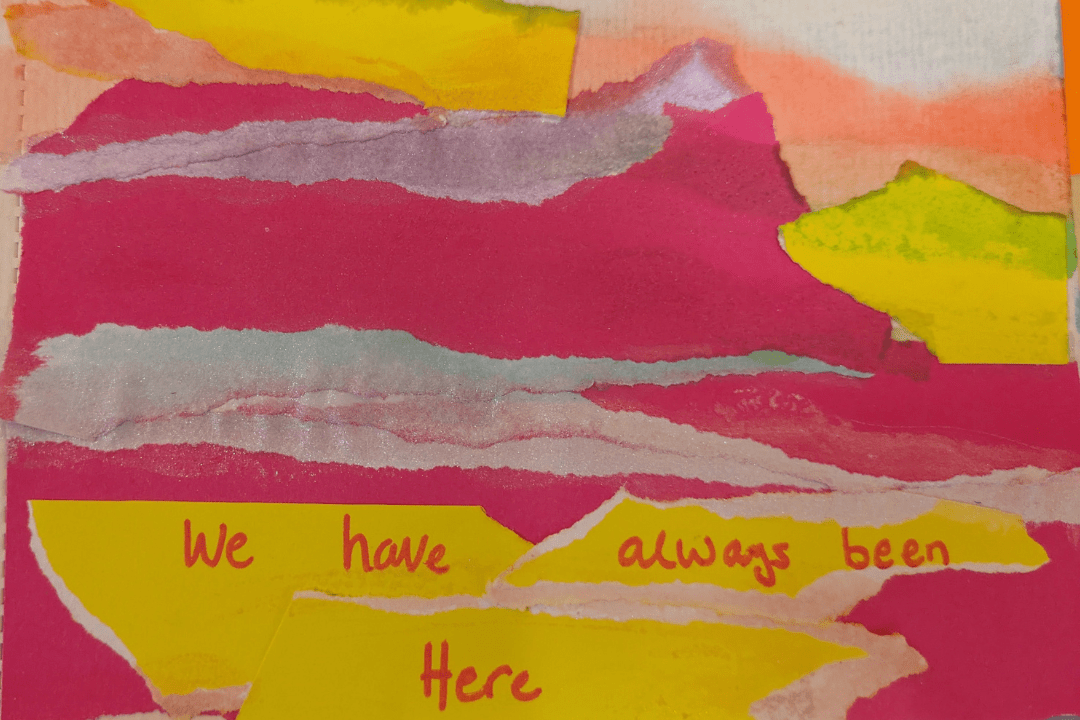
Launching Our Transcapes and its reception
On Saturday 27 September 2025, we delivered the first public iteration of the Our Transcapes project, collaborating with a local queer hiking group, Peak Queer Adventures. Here’s how it went!
What is Our Transcapes?
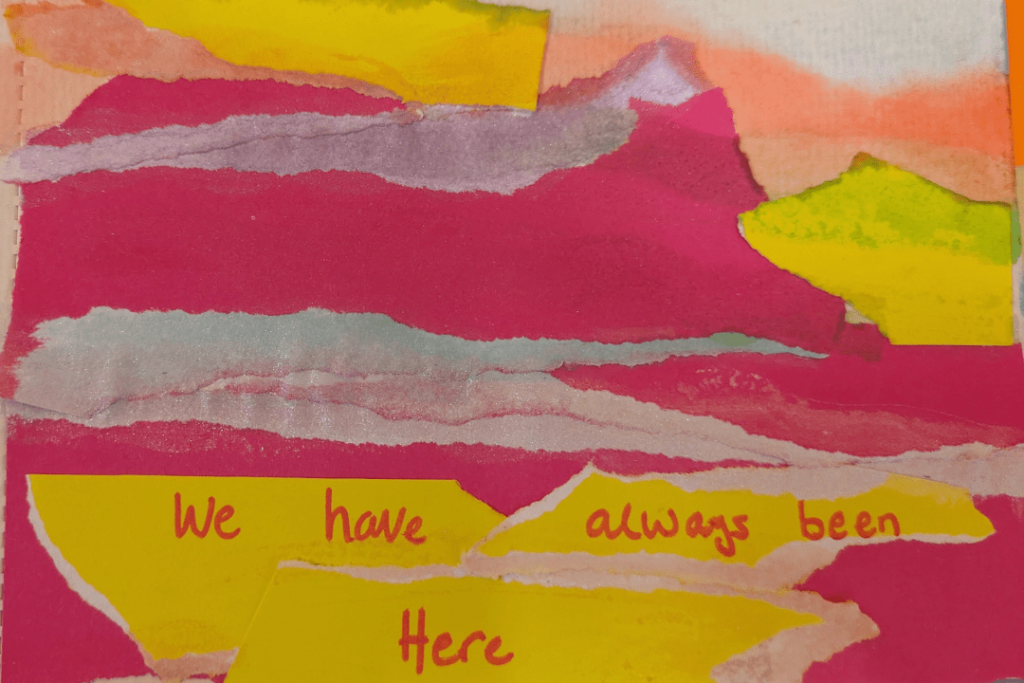
Our Transcapes is a walk and creative workshop which together explore how ‘non-duality’ – a life-view that doesn’t prescribe to binary oppositions and biological essentialism – was spiritually valued in prehistoric Britain. The project seeks to refute our present-day sociocultural myths of transness – and, more widely, of queerness – being something new and unnatural.
In a time of increasing transphobia and its negative impacts on trans* people’s mental wellbeing, I wanted this event in part to celebrate Britain’s (tr)ancestry: a past that acknowledges the fluidity of peoples, communities and cultures that have walked and shaped this land, including those that didn’t fit the mould.
How it works
The event starts with a psychogeographic tour through ‘local’ landscapes (landscapes people are in proximity to at that specific time, rather than ‘where they’re from’) that are similar to prehistoric ones. Along the walk, we talk about prehistoric artefacts and tell stories from different periods that show how non-duality was valued in the past, and the dualities we often think of as ‘true’ today were often challenged (human/animal, nature/culture, man/woman).
Then, through imagined dialogues with these artefacts, we apply creative writing approaches and narrative psychotherapy ideas to a workshop. The workshop is to help participants consider their own power, value and belonging in their transness. Finally, participants are invited to create something based on what they’ve experienced during the day.
Project goals
This public launch of the project sought to test three therapeutic goals. Could these three strands of creative and communal activity support the mental wellbeing of trans* folks today?
- Community building (reducing feelings of isolation – only 0.4% of the UK population openly identify as trans*)
- Connecting with nature (remembering our animality and beingness beyond our gender identities)
- Increasing feelings of belonging and naturalness through an exploration of trans* prehistory.
Our day with Peak Queer Adventues (PQA) put these goals to the test.
Preparing the project
The location
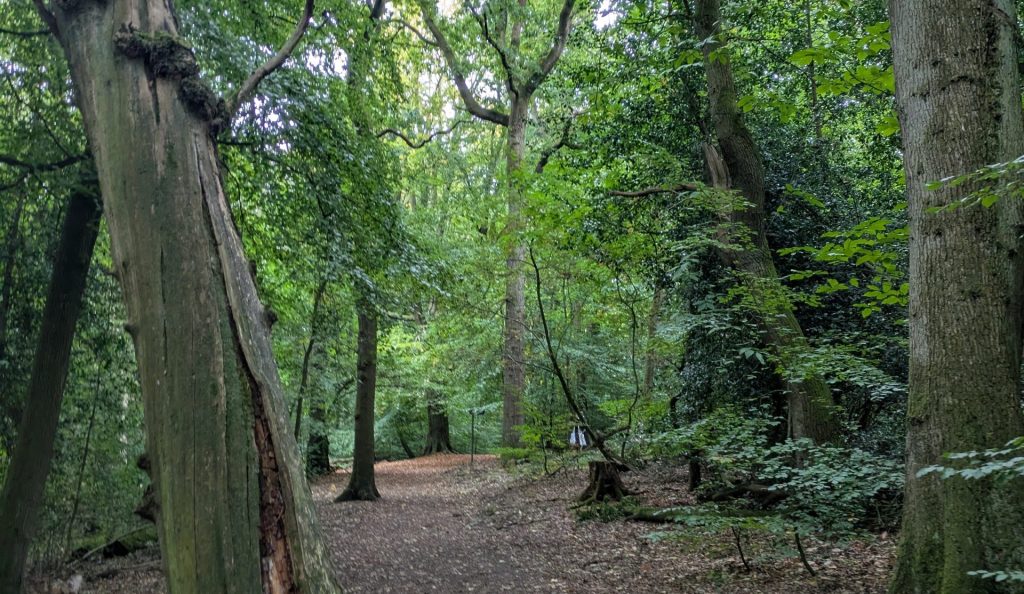
We chose to run September’s event in Sheffield’s vast ancient woodland site, Ecclesall Woods. The site offers a variety of landscapes that can be experienced as microcosms of prehistoric ones, from the Mesolithic’s heavy woods and lakes of post Ice Age Britain, to the Iron Age’s open glades and riverways. This allowed us to explore our prehistoric stories and artefacts in settings that brought them to life.
I would describe the experience as immersive and integrated. If I was to draw comparisons, I had an emotional response, something which I rarely feel within the traditional, museum/gallery like context. I guess the key word here would be CONTEXT! These objects had a place in which they lived and functioned, a landscape they were born from and contributed to, and seeing them within that world reanimated their bodies and imbued them with spirit.” – an Our Transcapes participant
Ecclesall Woods is reachable by public transport (the costs of which we reimbursed), making the event easy to access. Finally, with its Discovery Centre in the middle of the site, it’s a friendly location offering accessible amenities, a private-hire room crafted from the forest’s wood, and a balcony with access to a pond and forest views that could be used for socialising over lunch, or as a setting for the creative workshop.
The artefacts
In 2024 I learned at an academic and arts conference about the value of physical objects – of materiality – in helping us embody learning. Before this, I had really only been interested in words and visual art you can’t touch. It changed my perspective on how to approach Our Transcapes.
After the conference, I engaged with three different artists to ensure there were physical objects on the project that participants could engage with as a form of learning and embodied experience:
God dollies
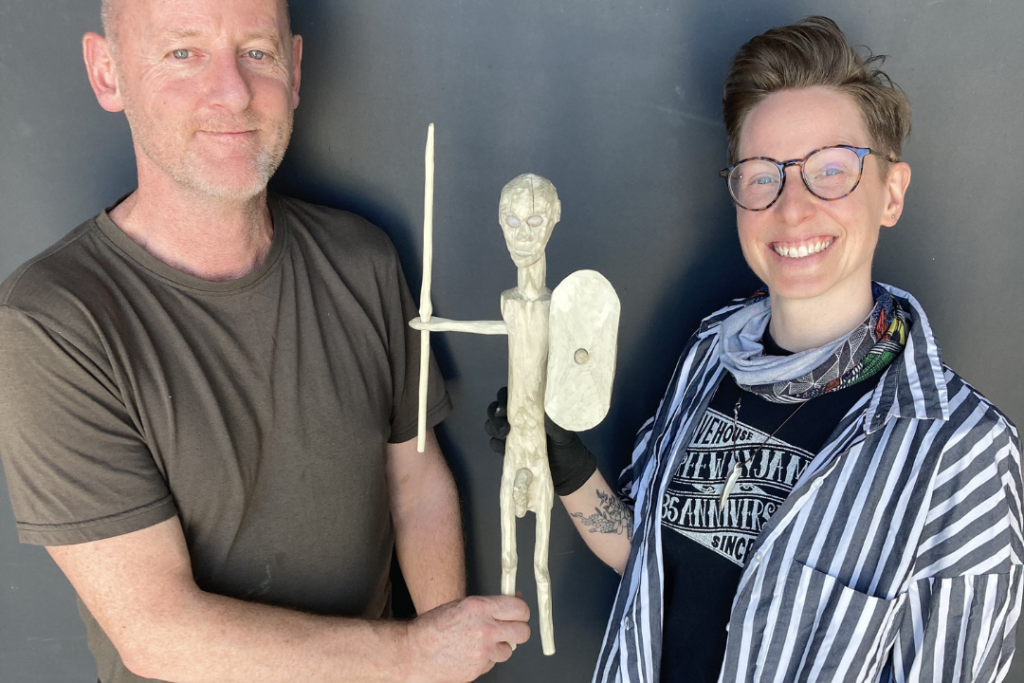
I commissioned a replica Iron Age Roos Carr figurine from Sheffield wood sculptor Jason Turpin. Jason really understood the brief, applying Iron Age crafting techniques, visiting the real figurines in Hull’s Archaeology & Anthropology Museum, and using only found foraged wood and quartz.
God dollies appear across Europe and Britain and represent people in non-realistic ways. Many found in Britain and Ireland have interchangeable biological sex markers, such as removable phalli, or having both phalli and breasts. Often standing at the boundary of bogs and other unpredictable, ‘un-managed’ landscapes like marshes, archaeologists believe the figurines had apotropaic (protective) power.
Star Carr deer headdresses
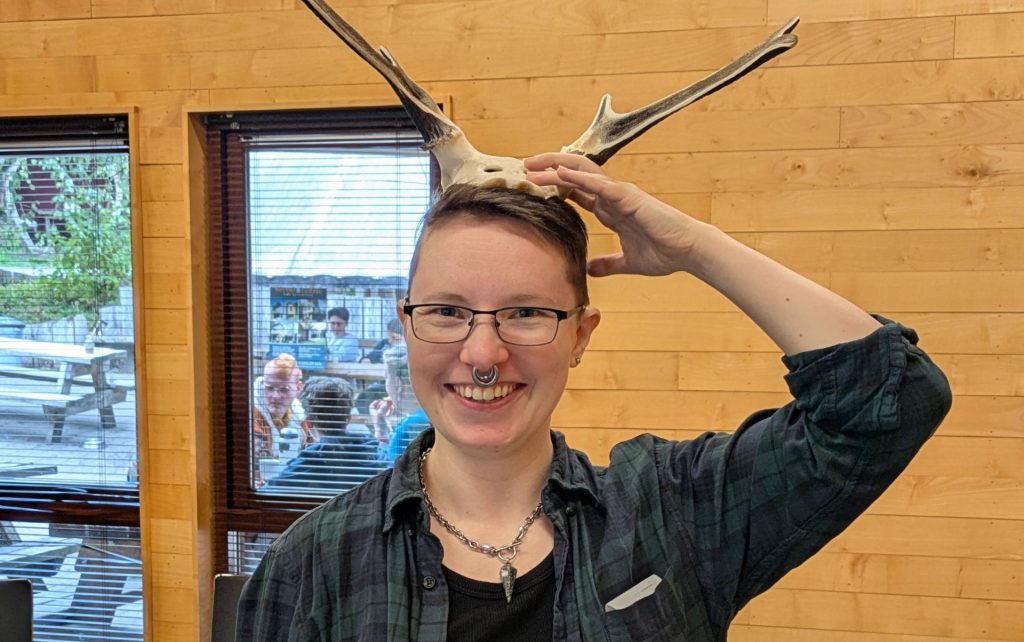
An Our Transcapes participant wearing the headdress
Dr James Dilley, an experimental archaeologist who teaches at the University of Southampton, also creates prehistoric British artefact replicas for museums as Ancient Craft. He made our Mesolithic Star Carr headdress using Mesolithic techniques.
The Star Carr headdresses are one of the earliest artefacts ever found in post-Ice Age Britain. Archaeologists think they were worn to support people on a hunt by imitating and engaging with deer, or as part of ceremonial wear. In both cases, it appears to have been believed that wearing an object made from the material of a powerful animal could imbue the wearer themselves with that power, blurring the boundary between beings.
Lino Folk: archaeology-themed linoprints
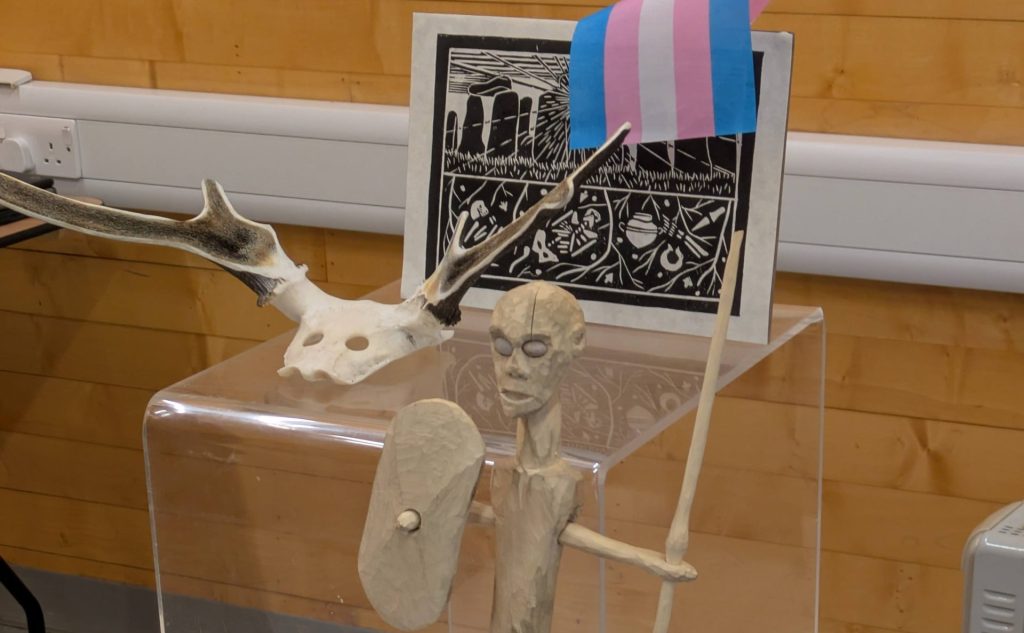
Discovering a local trans* artist, Lino Folk by Fiona, at Sheffield’s Kelham Pride, I bought some beautiful prints that represented queer interpretations of various archaeological sites and objects.
One such print by Lino Folk sums up the Our Transcapes premise fantastically. It shows a neat, symmetrical Stonehenge at a solstice – all straight lines and guiding light – and the contrasting messy, natural earth beneath. The earth is mixed with remnants of human activity: pottery shards, skeletons, and other items that challenge and enrich our traditional ideas of what prehistoric Britain is. Those hidden stories are often missing from the history books and school lessons and are brought into the foreground by Lino Folk and Our Transcapes.
All of these artefacts and artworks helped bring the past to life for participants.
“I cannot overstate how much I valued having the reconstructed physical items there in a way we could touch and interact with. I am always interested in history, but those made it so, so much easier to connect with an understanding, and I liked that it meant this project was also supporting those artists with really niche archaeological skills.” – an Our Transcapes participant
The launch of Our Transcapes
Meeting and greeting
In September 2025, 13 participants and a fully trans* delivery team met at the Discovery Centre in the late morning. Many participants were meeting for the first time, and despite all being members of PQA, I hadn’t met the majority of participants, either. For some, it was their first PQA event. For one participant, who was early on in their trans* journey, it was their first time ever meeting other trans* people.
“I was looking forward to an interesting event on a topic I didn’t know a lot about, but wasn’t sure exactly how it would pan out or what I would learn. I certainly wasn’t expecting it to be such a profound experience. I felt a bit anxious at the start of the event when people started arriving.” – an Our Transcapes participant
We started with some tea and coffee so participants could meet one another and break the ice. We then chatted about what to expect from the day, along with some facilitation containers: how we’d all try to show up and respect one another. Using the Lino Folk’s Stonehenge print, we then introduced the premise of the day: finding the stories hidden beneath our typical ideas of prehistoric Britain through queer archaeology.
“Before, I was vaguely aware we’ve always existed, but didn’t have the specific knowledge to talk about that in more detail. I also really enjoyed the opportunity to do this learning in a lovely supportive group of trans people, some who I had met briefly before, and others who were new to me, but everyone was really interested and engaged, and it facilitated conversations to support our present day trans community, too.” – an Our Transcapes participant
The walk: applying psychogeography
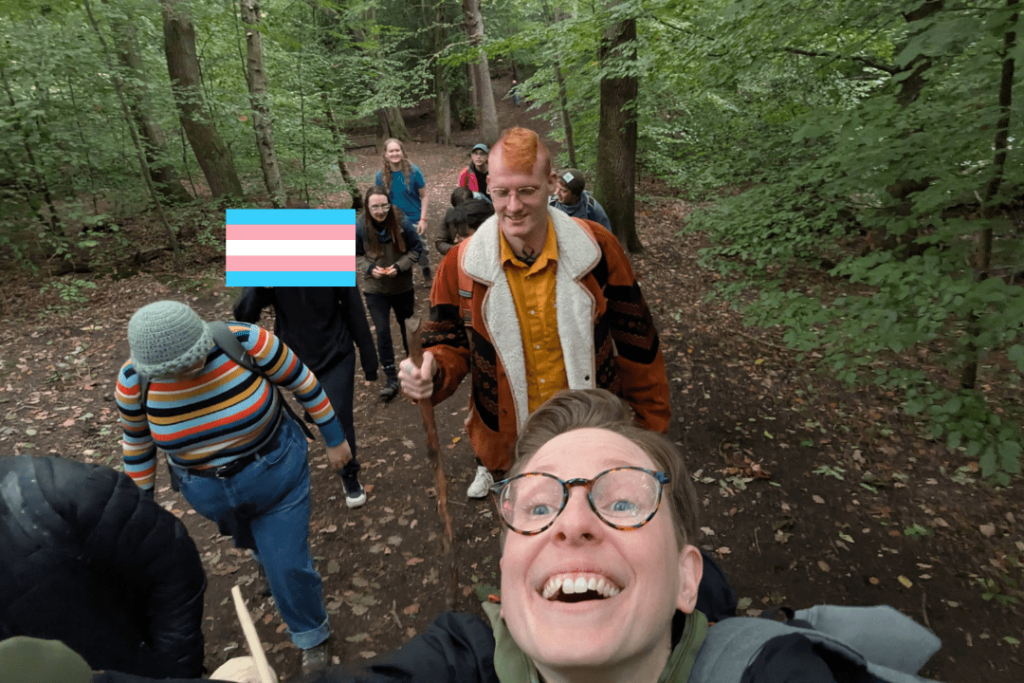
I first learned about psychogeography as a Creative Writing BA student, back in the day. It really fascinated me: how different affects and experiences can come from exploring the same place when certain narratives, guidance or creative engagement are introduced.
It was essential that we worked with the landscape for our storytelling for this event. Firstly, people in the Stone, Bronze and Iron Ages were far more present in, and reliant on, the ‘outside’ world then we are today in Britain. More importantly, trans* folks taking up space in the outdoors challenges the idea that they don’t belong there – and allows for ecotherapeutic healing when they have access to ‘nature’ in a way that feels safe.
“It was a special experience to spend time in nature with other trans people. It would be nice to do something like that on a regular basis. I loved being with people who don’t stare or make me feel ‘other’ due to my gender presentation.
In fact, I felt as though, as a nonbinary person, my existence may have been more highly regarded at other times further back in Britain’s history. I didn’t just feel included, I felt celebrated. Through the stories and artefacts SK shared, I felt I gained a much greater knowledge of the history of gender nonconformity in my own country. Often when I read about such histories it is in relation to other cultures.” – an Our Transcapes participant
On the walk through Ecclesall Forest, participants connected over mushroom identification and pointed out beautiful things to one another along the way. We stopped at a large pond, which hosted a microcosm of flora and fauna we might’ve seen in Mesolithic Britain and Ireland. We chatted about the Star Carr headdresses and their potential links to inter-world spiritual travel, non-human animal and human animal hybridity, and gender fluidity.
“As a trans person I loved finding out that ancient societies may have been less binary than we often think of them. I enjoyed spending time with other trans people. There was time to pay attention to the woods and notice the different tree types and fungi.” – an Our Transcapes participant
Moving further into the woods we came to glades and clearings – emulating the coming of farming to Britain and the forest clearances of the Neolithic (New Stone Age) – before stopping at a flowing stream to discuss possible Iron Age beliefs around sex fluidity and apotropaic (protective) spiritual power.
“I really loved that we were able to touch and interact with the objects. They made it feel a lot more real, and I think will also make a big difference to me remembering more of what we learned. I really enjoyed being *in* the landscapes as we learned about them, it gave more context and perspective and linked it more to how we live here today.” – an Our Transcapes participant
As we talked, folks asked questions and discussed things as they walked. Someone had a lot of interest in neo-paganism and offered insights around animism from a different perspective. All contributions were welcome – I wanted it to be an event that wasn’t hierarchical or formal, but an open space where connecting ideas and thoughts were welcomed.
Through the walk, our project’s therapeutic goals 1 and 2 – community building and connecting with nature – were achieved!
“Being in a group of trans* people who have similar interests to me was a really nice experience. I have quite high anxiety a lot of the time but I felt relatively calm in the group.” – an Our Transcapes participant
Community connections
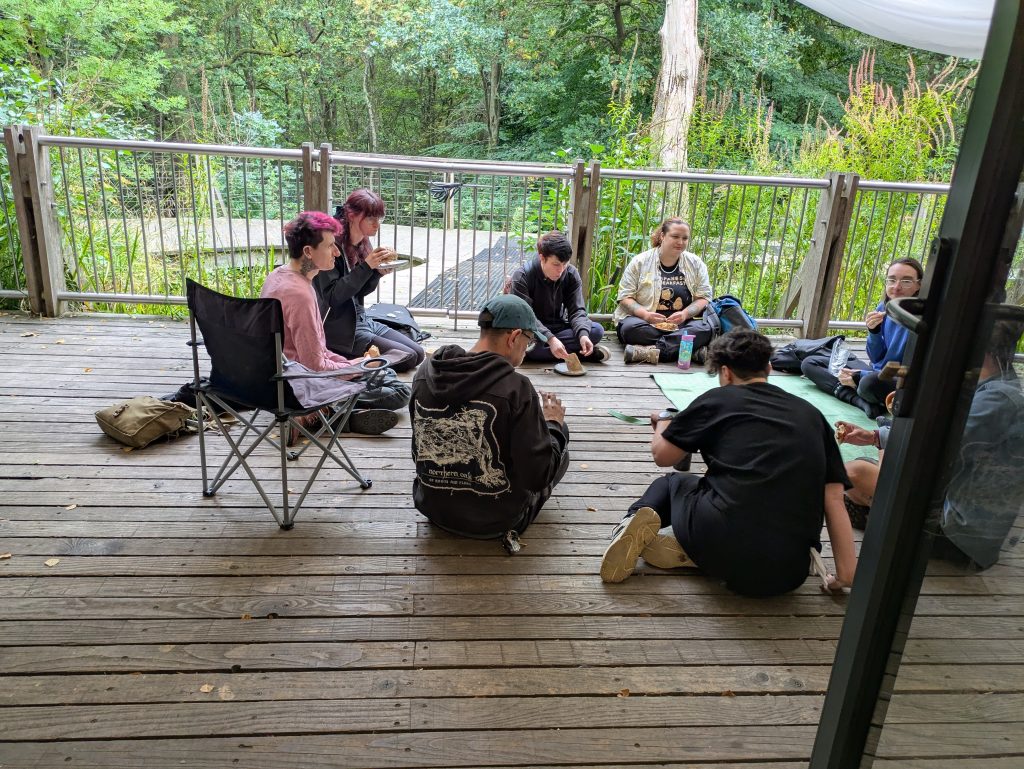
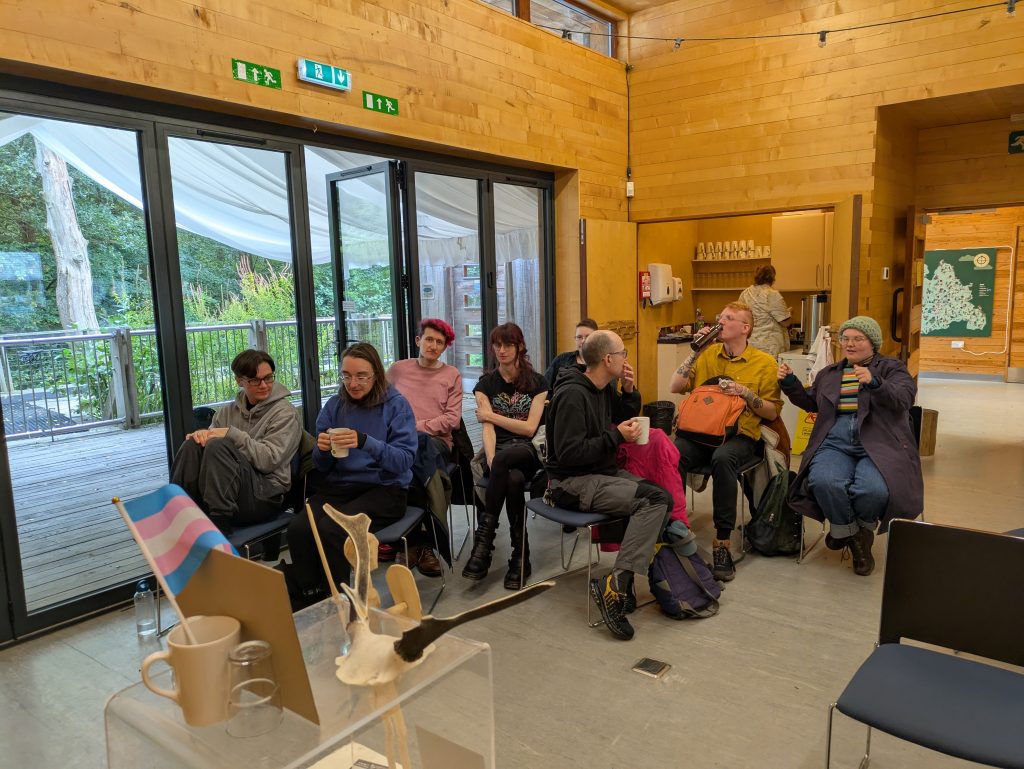
Heading back to the Discovery Centre, we shared lunch. Therapeutic goal 2 got plenty of look in, as folks sat in a large circle to eat together and chat. People who wanted some quiet time could have that space, and those with various accessibility requirements could rest.
“S. K. went to great lengths to ensure the event was accessible and took into account people’s energy levels and access needs, making it possible for me to take part in the event and enhancing my connection to the topics.” – an Our Transcapes participant
Crafting the creative workshop – learnings
The creative workshop was the most difficult and delicate part of the event to plan. My previous creative writing-inspired idea had asked participants to imagine being these artefacts: objects made by a community who believed they were powerful because of their non-dual qualities.
The objective through this idea was to apply creative writing techniques to indirectly challenge any internalised transphobia or self-esteem issues participants may hold by asking them to align themselves with these powerful objects. This would, hopefully, help participants understand that the transphobic rhetoric of today was only a story – not ‘The Truth’.
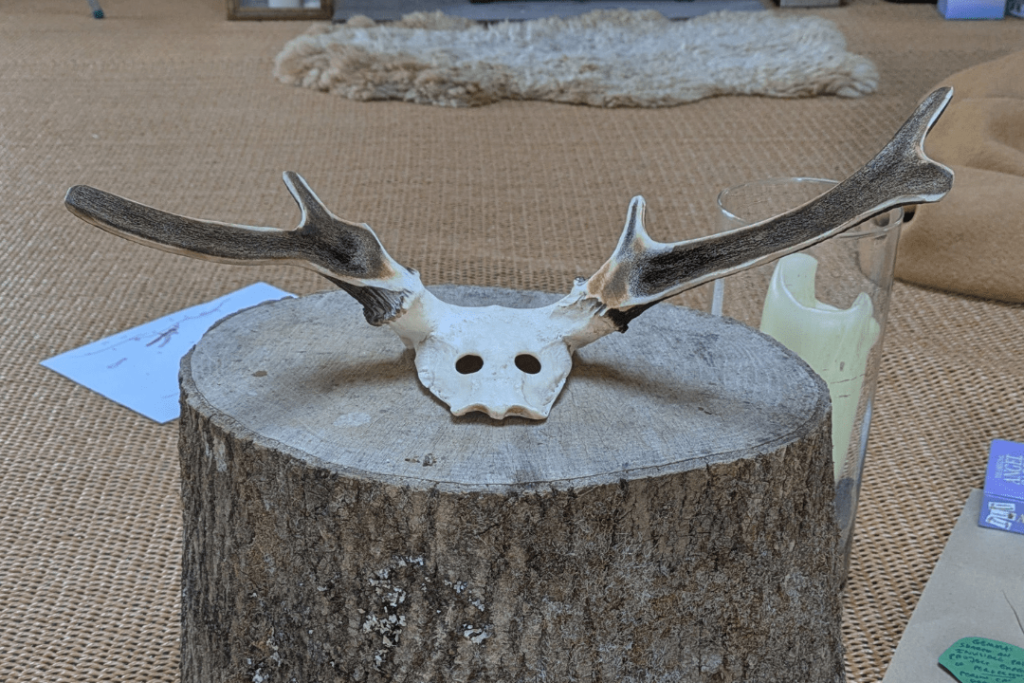
When trialing this idea with the Queer Natures team in March 2025, however, it became evident that this question could make participants feel more vulnerable than empowered. The whiplash between imagining ourselves as being respected for our ‘differences’ presented such a drastic contrast to our lived realities that the comparison could cause harm.
So, inspired by the retreat’s facilitator trainer, Lakshnie Hettihewa, I reconfigured this part of the workshop. Instead of embodying these artefacts, we asked participants to hold an imagined dialogue with them, asking the artefacts the following questions:
- What do you think makes you powerful?
- What do you think makes me powerful?
- [A question of their choice.]
This allowed empowering answers to arise – seemingly from these powerful objects – but really within the participants themselves. Using the artefacts as conduits to their own internal knowledge allowed participants to explore themselves in a less confrontational way.
“When SK invited us to have a conversation with an object, I asked about the lives the headdress had lived – both as a deer and as the person who wore it. I thought about the symbiotic nature of the connection people had to the land. Through this dialogue with the object I was able to feel my connection to the land, to people and to all the “ancestors” (beyond human) who have touched my life and who I am and find power in that.” – an Our Transcapes participant
Creating our power
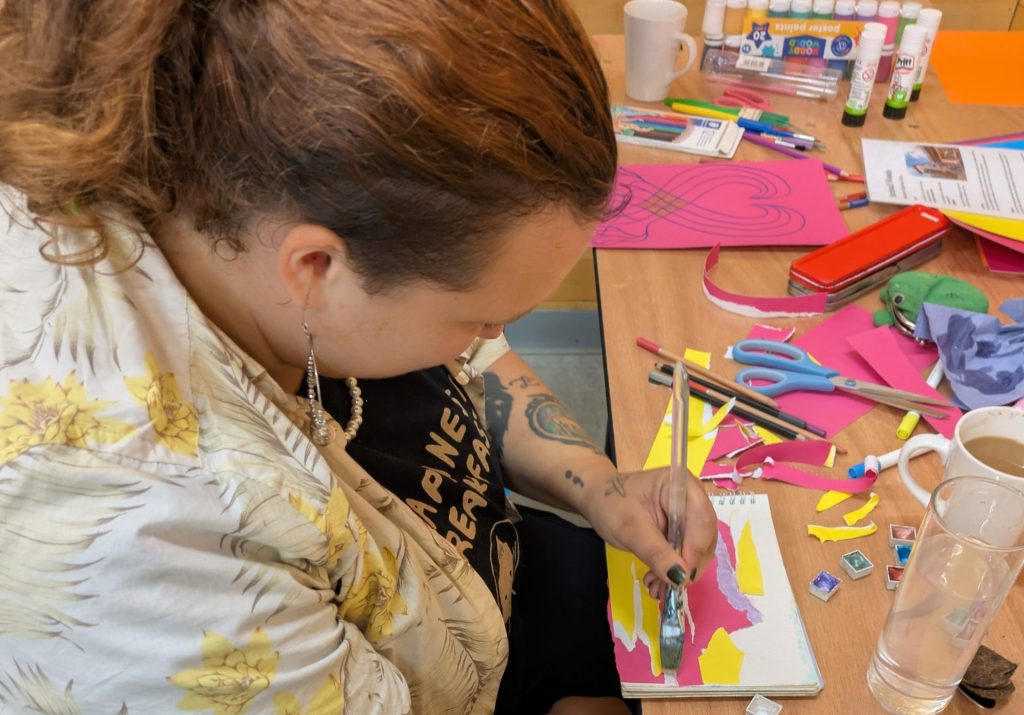
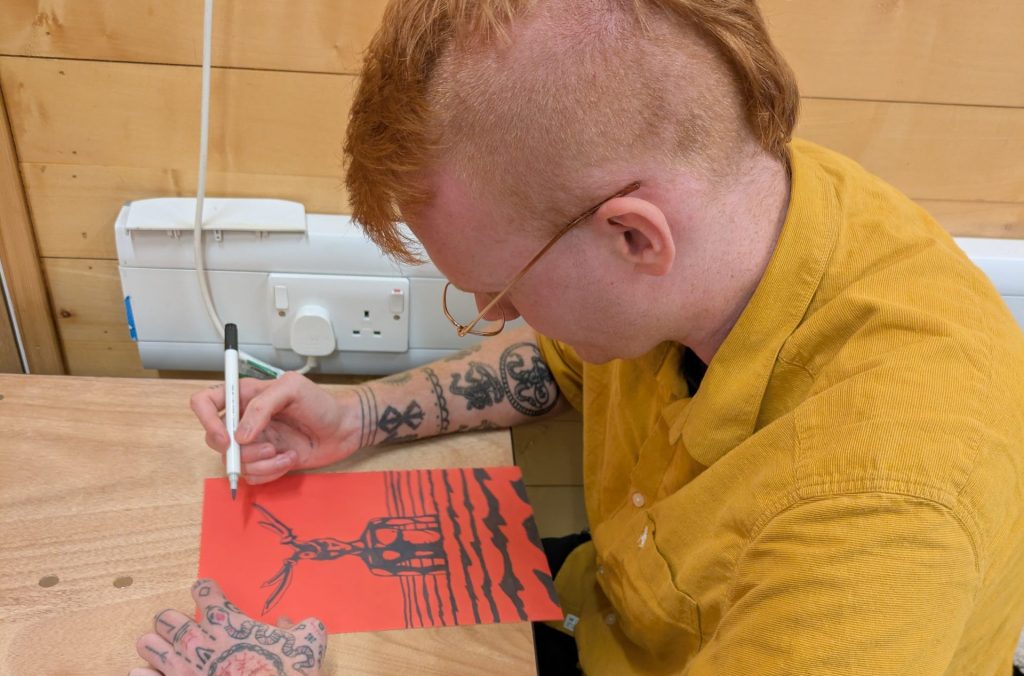
After this dialogue, participants were invited to make, draw or write something, using anything they had experienced or learned during the day. They made fantastic works that demonstrated the successful impact of therapeutic goal 3: increasing feelings of belonging and naturalness through a queer exploration of prehistoric Britain.
“It was reassuring to learn about the attention and respect given to the feminine and masculine pre division of gender roles/the patriarchy in the extremes we see today.” – an Our Transcapes participant
Assessing the project’s impact
Written over a year ago, my first blog about the project shows the original thinking behind my methods when I designed this event – and a week after running Our Transcapes for the first time, I cried while reading the feedback from participants. Every therapeutic goal was represented.
We measured impact through a post-event survey and the creative outputs of the group, as well as some anecdotal wins. 9 out of 13 participants completed the survey.
- 8 out of 9 survey respondents gave the event 5 out of 5.
- All survey respondents agreed that the pre-history objects helped them feel better connected with their local landscape.
- All survey respondents strongly agreed that taking part in the event helped them feel more connected to nature.
- All participants agreed or strongly agreed that they felt more connected to other people after the event.
- All but one respondent said they felt more connected to British history after the event. The participant who felt neutral about this explained that they didn’t have any interest in history. I felt this was an incredible answer: it showed that when history was made relational to their identity and interests (i.e., trans rights or trans belonging), they would attend a four-hour event exploring it – despite their general lack of interest in the subject area.
- Many participants stayed after the event had finished to further engage with the artefact replicas, trying on the headdress, despite that the event had already been a long day.
- All qualitative responses were so insightful and generously shared, and showed how deep the impact of the event was for participants.
“SK took us through a local woodland I am not very familiar with and used the landscape and the objects to tell stories which connected the land, and people in the past to us today. Their approach dispelled ideas about binary and oversimplified distinctions between people and nature and instead situated us within it.
Imagining the interaction of the objects with the land, I was able to situate myself within it too. I experienced the seasons – changing leaves and mushrooms – for the first time this season with others who were interested [in paying] attention to our surroundings with awe, something which was brought to life further by SK’s storytelling.” – an Our Transcapes participant
As a developing creative facilitator, I learned from the event where the gaps were, how easy it is for time-keeping to slip, and what I can do to make the event more enjoyable for everyone. As a researcher interested in the therapeutic powers of creative writing approaches and narrative psychotherapy-inspired activities, I was delighted to see that these kinds of creative practice had a positive impact. An enormous thank you to the participants who took the plunge on this new project and to the wonderful Queer Natures team, who helped it come into being.
Looking to the future
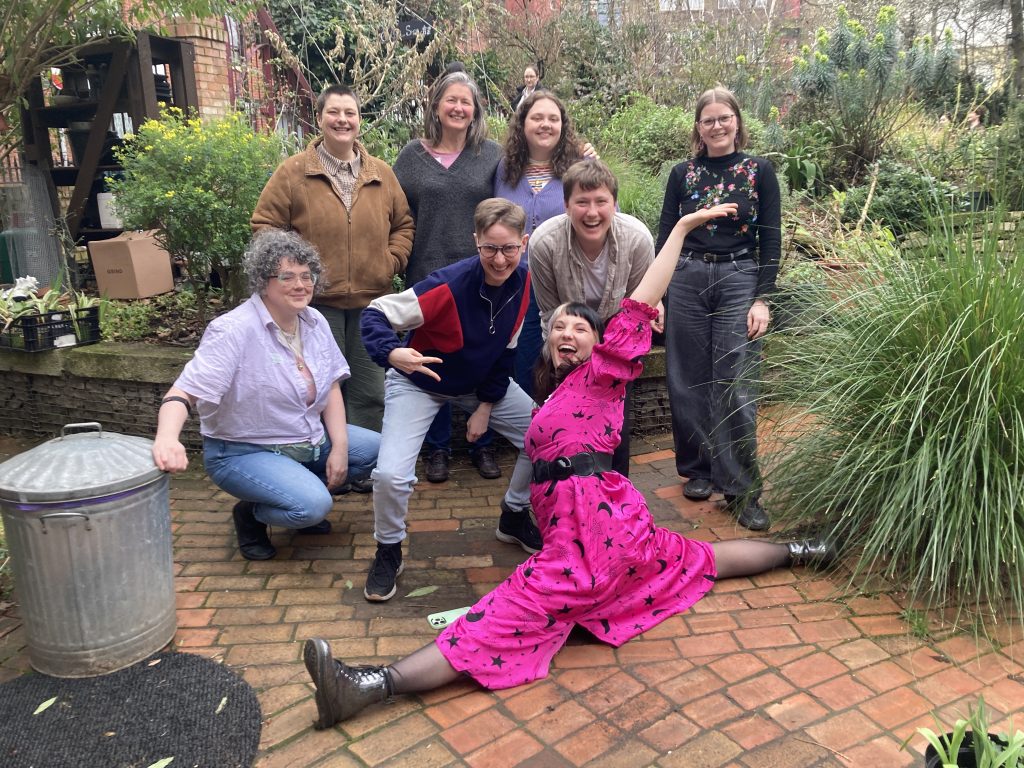
During a fantastic away day with the Queer Natures project team in February 2026, we all had the chance to reflect on our time on the project, but also looked at how we could continue this important work beyond it.
As an artist and researcher, I hope to further develop and broaden the reach of Our Transcapes beyond Yorkshire through an Archaeology in Practice PhD, exploring the social justice and therapeutic benefits archaeology can offer when combined with creative practice.
After this, I would like to write the first non-fiction book that explores non-duality in prehistoric Britain and Europe, helping to expand the reach of this important, forgotten history even further.
Taking part in Queer Natures has not only strengthened my self belief as an artist, but shown that many of the things that have helped me accept and celebrate my own trans* identity can be delivered in ways that help others. It has changed the direction of what I want to do and achieve in the next five years, and I have worked with so many wonderful artists, creatives and researchers on this project who I very much hope to work with again.
An enormous thank you to our funding body, the Arts and Humanities Research Council, to the University of Exeter, and to everyone who helped shape this project. Here’s to our transcestry!