
Queer kinship with the badgers of Streatham Campus
By Lachlan Evans
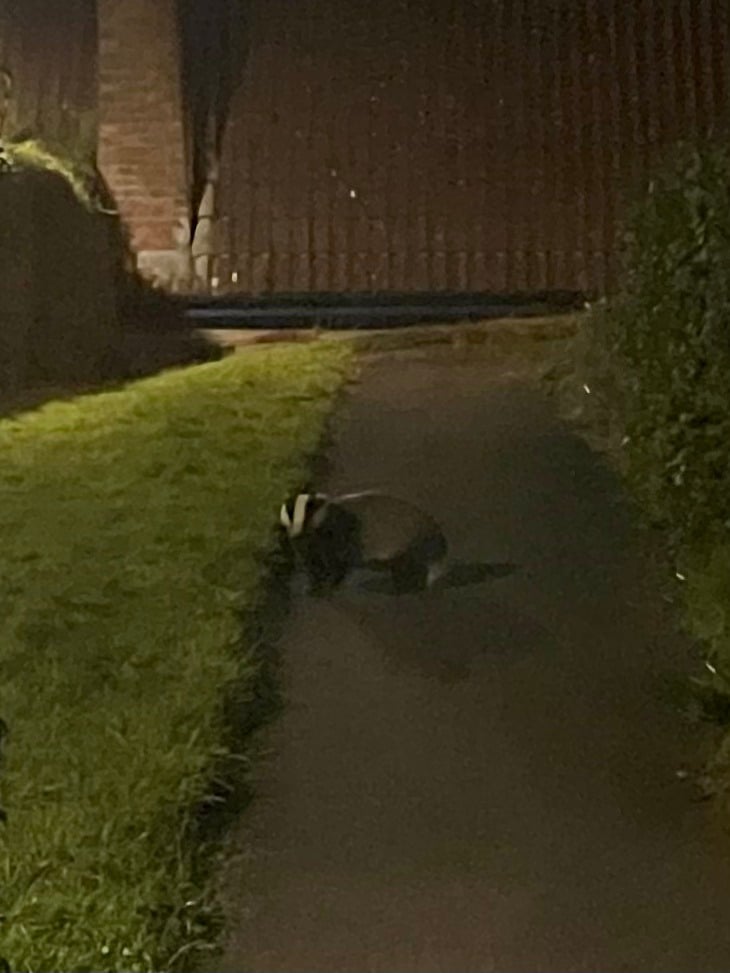
Above: An encounter I had with a badger while walking home late at night behind the Thornlea Building
In Animal Rights: Considered in Relation to Social Process, Henry Salt writes: “Oppression and cruelty are invariably founded on a lack of imaginative sympathy; the tyrant or tormentor can have no true sense of kinship with the victim of his injustice”. This brings to mind Donna Haraway’s words in Staying with the Trouble: Making Kin in the Chthulucene: “My purpose is to make “kin” mean something other/more than entities tied by ancestry or genealogy” (102). Salt and Harraway’s views on kinship have strong queer implications, decentring the constellation of human and non-human connections from the heteronormative standard of the family tree. In this article, I want to illuminate a queer kin which I have encountered on Streatham Campus—the badger.
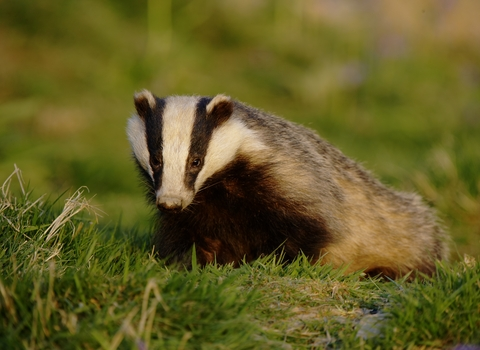
(Devon Wildlife Trust)
The European badger (Meles meles) has been living in England for up to 500,000 years, and is most commonly found in the Southwest. The University of Exeter’s Special Collections Archive houses materials documenting how people living here have interacted with badgers historically. Brock, farmers friend is a newspaper article written by W. J. Wallis on the 22nd October 1962. Wallis describes a badger named “Brock”, a common nickname for the species originating from their Old English name brocc, who was found in a hen-roost by a farmer in the Devon area. Wallis displays a great deal of affinity towards Brock, though admits he did not always feel this way. He recounts a previous experience of being asked to kill a badger by a Devonshire farmer:
“The farmer reported that he had seen a lamb being dragged into the small sett, so off I went, complete with terrier, to dig out the culprit. We soon found the badger, but no trace of the lamb either in the sett or in the badger. Instead, we found the remains of thousands of beetles. This fact and stupid damage to a dog later, put me off badger digging forever”
This account highlights one example of the unfair stigma around badgers as being menaces, which dates back years. Badgers have a long history of suffering at the hands of humans who do not treat them with the respect of a living creature. One example from Exeter is a report in the Western Morning News on the 28th of November 1969 which describes “The horribly-cruel and almost obsolete sport of badger baiting”. This incident which was reported in the area involved “several dogs in succession [being] set at the poor brute, mangling his flesh until he at length became exhausted and, in order to preserve for baiting a future day, was released from the tormentors and taken away in a sack”. This atrocious ‘sport’ has been practiced for years and is one example of prolonged violence against badgers.
Another example, however, relates to the long public debate surrounding their involvement with bovine tuberculosis—which posed a serious threat to cattle farmers and their livestock. There was split public and scientific opinion on whether a culling of badgers would be effective in preventing this. Michael McCarthy writes “’badger culling cannot meaningfully contribute to the control of cattle TB in Britain.’ […] killing the animals on a large scale would, counter-intuitively, tend to increase rather than diminish the incidence of the disease. That was because individual badgers missed in a cull tend to wander about the countryside after their social group has been broken up, spreading the TB bacterium as they go” (31).
Badgers throughout history have been gassed by paranoid farmers who suspect they are the sole cause of their dying cattle, without investigating other modes of prevention which do not involve killing badgers, even when these methods may be more effective. This paranoid violence closely resembles the experience of the queer community during the AIDS crisis, in which queer people were not only suffering from the devastating disease, but from the heightened oppression that accompanied it. They were subject to large-scale discrimination from people who were uninformed about the true nature of HIV/AIDS and its transmission, with this having global implications which continue to impact the world today.
In the play The Badgers (1980) by Mark Beeson, ‘The Ministry’ seek to gas a group of badgers living in Dartmoor and destroy them in their hidden underground burrows because they falsely believe them to carry a disease. The violence of The Ministry can easily be read through the lens of heteronormative violence enacted upon the queer community not just during the AIDS crisis but throughout the past and the present: “What’s this we see? Will the Ministry / Destroy us before they’ve heard our plea? / Though we mayn’t be wealthy / We’re certainly healthy / And produce all we need just to be. […] If we don’t increase the Nation’s ease / Does that mean badgers have got disease? / We find the stigma / A faint enigma / When leisure is making the Nation obese” (32).
In their Essay Sex in Public, Lauren Berlant and Michael Warner write: “The queer world is a space of entrances, exits, unsystematized lines of acquaintance, projected horizons, typifying examples, alternate routes, blockages, incommensurate geographies. World making […] is dispersed through incommensurate registers, by definition unrealizable as community or identity” (558). In this sense, queer kinship with badgers is not based on heteronormative notions of “community” and “identity” but rather “lines of acquaintance”, reflections of the queer experience in other, non-human forms of life. This illustrates how we can find “Collective histories of oppression” (Yep, Alaoui and Lescure) reflected back at us, not just from other queer people, but even across species.
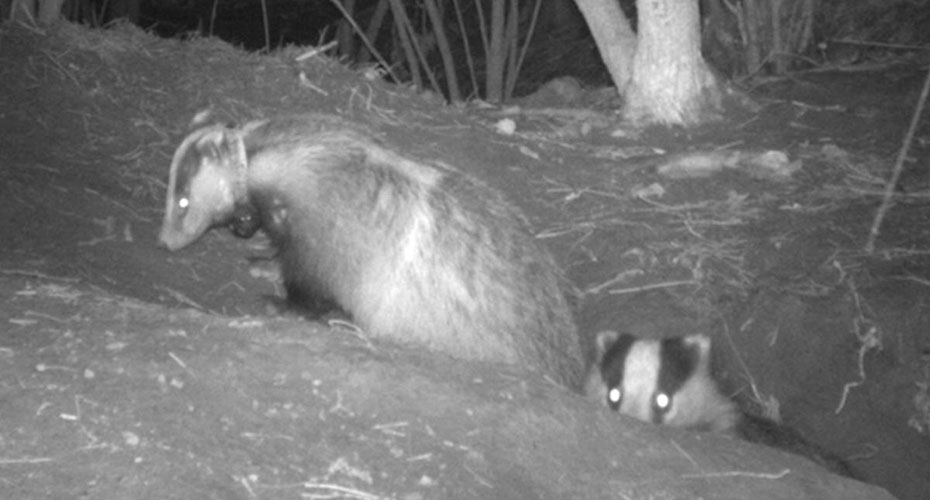
(University of Exeter)
Moreover, queer world-building and kinship is not only to be found in shared experiences of violence. Badgers also exhibit extremely low sexual dimorphism, meaning it is very difficult to tell males and females apart. In his 1989 book The Social Badger, renowned carnivore biologist Hans Kruuk noted:
“It is extremely difficult to tell the sex of a badger just from its face; a boar [male] is somewhat broader in the jaw, but there have been many times when I was wrong in my determined attempts to sex badgers that way. On several occasions I have had a badger in a trap and confidently told bystanders that we had caught a sow [female], judging by the head, only to be confronted by irrefutable evidence to the contrary after anaesthethizing the animal. Some larger boars had a quite unmistakable head, but many I found difficult to identify as males—and I know that this happened to other acknowledged experts, too.”
It has been thoroughly documented that male and female badgers vary dramatically in features which are sometimes used to determine their gender. As such, while it may be possible to occasionally guess the gender of a badger you encounter, they are in many ways genderqueer animals in that they do not conform to any strong biological binary, being almost completely androgynous.
To conclude, badgers are an example of a species which can spark many queer connections. Through the critical lenses of those such as Haraway or Berlant and Warner, we find ways of relating to badgers in strange and unusual ways. The experiences of the queer community offer new and unique opportunities to understand these creatures, and perhaps to imagine that they might in some ways understand us. I have always found it a strikingly magical experience to encounter a badger on Streatham Campus, on the very few occasions I have. They are elusive animals typically wary of human contact, however the times when a
badger has frozen, regarded me, or even walked right up to me in the nighttime silence of my walk home, have felt remarkably special. My encounters with badgers prompted this research into how connections across species can be queered, but this is by no means limited to Meles meles. While exploring Streatham, what other species—plant or animal—do you see in a similar way? What other relationships with the natural world around you could be queered? What benefits can come from seeking these kind of connections in the most unlikely of places?
Works Cited
Baldwin, Marc. “European Badger Sexing.” Wildlife Online, Wildlife Online, 18 Apr. 2022, www.wildlifeonline.me.uk/animals/article/european-badger-sexing.
Beeson, M. “’The Badgers of Dartmoor’ annotated typescript”, Special Collections Archives. EUL MS 488/LIT/2/4. University of Exeter.
Berlant, Lauren, and Michael Warner. “Sex in Public.” Critical Inquiry, vol. 24, no. 2, 1998, pp. 547–66. JSTOR, http://www.jstor.org/stable/1344178. Accessed 4 June 2025.
Haraway, Donna Jeanne. Staying with the Trouble: Making Kin in the Chthulucene. Duke University Press, 2016.
McCarthy, M. “Should badgers be culled to check the spread of bovine tuberculosis in cattle?”, The Independent, 9 Apr 2008.
Salt, Henry S. “Animals’ rights, considered in relation to social progress, etc.” The William and Mary Quarterly, vol. 3, no. 3, Jan. 1895, p. 213, https://doi.org/10.2307/1914789.
Unknown. Western Morning News, 28 Nov 1969.
Wallis, W. J. “Brock, Farmer’s Friend”, 22 Oct 1962.
Yep, Gust A., et al. “Mapping queer relationalities: An exploration of communication at the edges of cultural unintelligibility.” Journal of
Homosexuality, vol. 70, no. 1, 29 July 2022, pp. 1–16, https://doi.org/10.1080/00918369.2022.2103875.